A Walking Guide to Mission Hills KS Fountains & Landmarks
You have driven past the Verona Columns a thousand times. You may have parked once for prom photos, or slowed at the roundabout to let a heron finish crossing. What most residents miss is that the columns, the swan fountain in front of them, the reflecting pool that runs down to the street, and the urns scattered along traffic islands were never meant to be seen in isolation. They were laid out as a connected civic art collection in the 1920s, and the whole thing still reads as one composition if you walk it in the right order.
This is a guide to walking it in the right order. No car. No detour to the Plaza. Just the pieces J.C. Nichols and the landscape architect S. Herbert Hare left inside the city limits, in the sequence they were designed to be encountered.
The shorthand version of Mission Hills history is "Nichols developed it in the 1920s." The longer version matters for a walk. Nichols hired Hare in 1924 to design the two landmarks that still appear on the city seal: the reflecting pool at the intersection of Ensley Lane, Overhill Road, and Mission Drive, and the Verona Columns above it. The city's own description of itself as "America's first and foremost garden community" is not marketing gloss written yesterday. It is the design brief the neighborhood was built to.
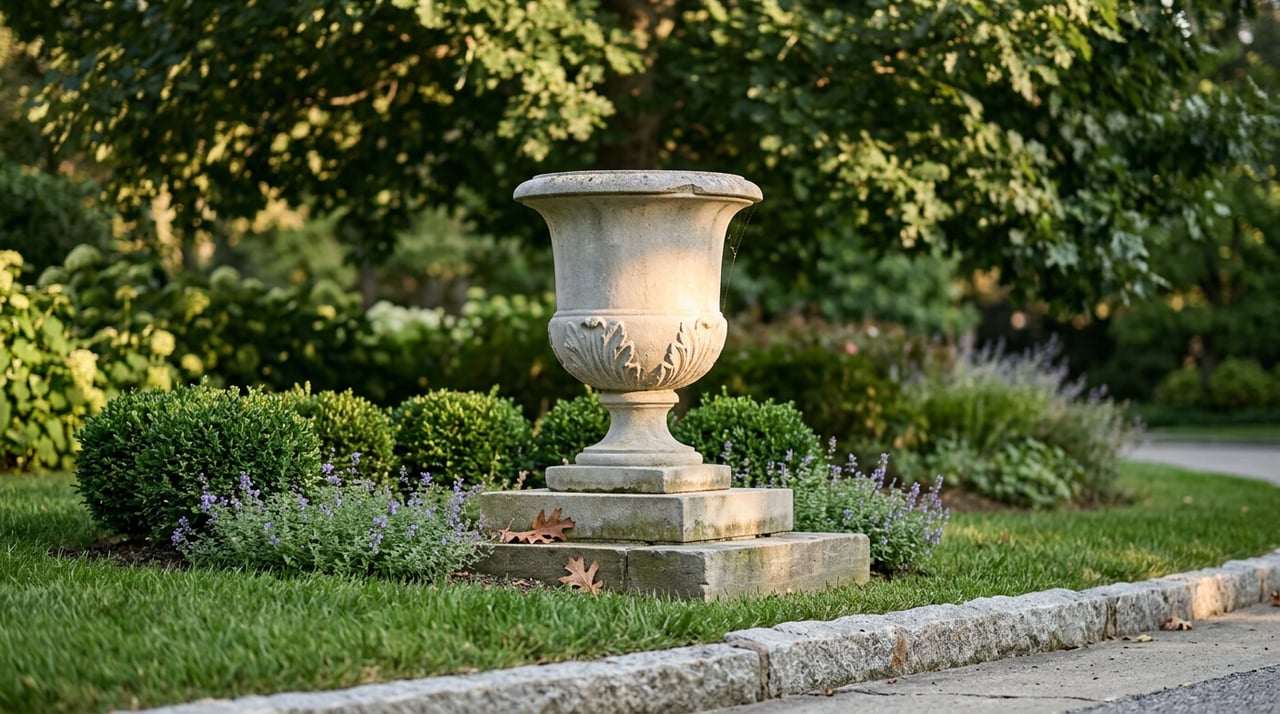
That brief is why the fountains, statues, sculptures and urns you see decorating traffic islands and roadsides include pieces that are hundreds of years old, many of them museum pieces imported from abroad. They were placed as sightlines, not decoration. When you walk past a stone urn on a median and then a fountain two blocks later and then a semicircle of columns at the top of a hill, you are reading a sentence Hare wrote a century ago. Driving through it, you get one word at a time.
Start at the reflecting pool at the foot of the columns and work outward. The whole route runs roughly a mile and a half depending on how many side streets you take.
Two things to know before you start. The columns and swans are a working prom and family-portrait backdrop most weekends between April and October, so early morning is quieter. And the pool's flagstone walk was rebuilt during a Mission Drive project a few years back, which is why the stone at the base looks newer than the columns above it.
Two annual events use the outdoor collection as their stage. Both are worth planning the year around if you have not been.
The Keim Street Fair is the one residents mean when they say "the Street Fair." The city keeps the format tight: open to Mission Hills residents and their families, no pets, and families are encouraged to bring blankets and lawn chairs. The city's own event page describes it as a stroll to the always-festive street fair full of friendly faces, food and fun, which is a fair description of the evening it actually turns into.
The Verona Columns Concert is the smaller of the two and the one that rewards showing up early. Programming has historically included the Brookside Brass playing classical, jazz, and contemporary sets in the park itself, with attendees bringing their own food and beverages because the city does not run vendors on-site. A blanket is not optional. There is nowhere to sit otherwise.
How seriously does the city take the columns as a venue? In 2010, during the final phase of the Mission Drive rebuild, the city closed the roundabout north of the columns, began demolition on the flagstone walk around the reflecting pool, planned to either replace or repair the pool depending on damage, and canceled the annual Verona Columns Concert on account of the renovations. A concert that gets canceled rather than moved is a concert that only works in one place.
Mission Hills has no restaurants or shops inside its own limits. That is a feature of the walk, not a bug. It means the loop has a natural finish line: the short drive or longer walk to one of the four adjacent commercial pockets residents actually use.
Because the neighborhood you bought into was designed as a garden with a house collection inside it, not the other way around. The public realm is the amenity. It just happens to be organized as a scavenger hunt that most people finish in fragments over twenty years of dog walks. Do the loop deliberately once, in order, at the right hour, and Mission Hills reads differently for the rest of the year. The columns stop being scenery. The urn on the median stops being anonymous. The heron in the water garden stops being an accident.
If you are thinking about the long arc of your time in the neighborhood, whether that is preserving an estate, transitioning a family home, or simply understanding what your street is actually worth as part of the Country Club District, The Gamble Group is happy to sit down for a conversation. Schedule a consultation when you are ready.
Stay up to date on the latest real estate trends.